C-Section vs. Normal Delivery Cost in Kathmandu: 2026
Medically reviewed by KNMC Hospital Last updated: October 2026
Overview
Choosing between a normal delivery and a C-section isn't really a choice most women make freely. It's a decision guided mainly by medical need, the baby's position, and how labour progresses on the day. Still, understanding both options and what each actually costs in Kathmandu helps you prepare rather than be caught off guard.
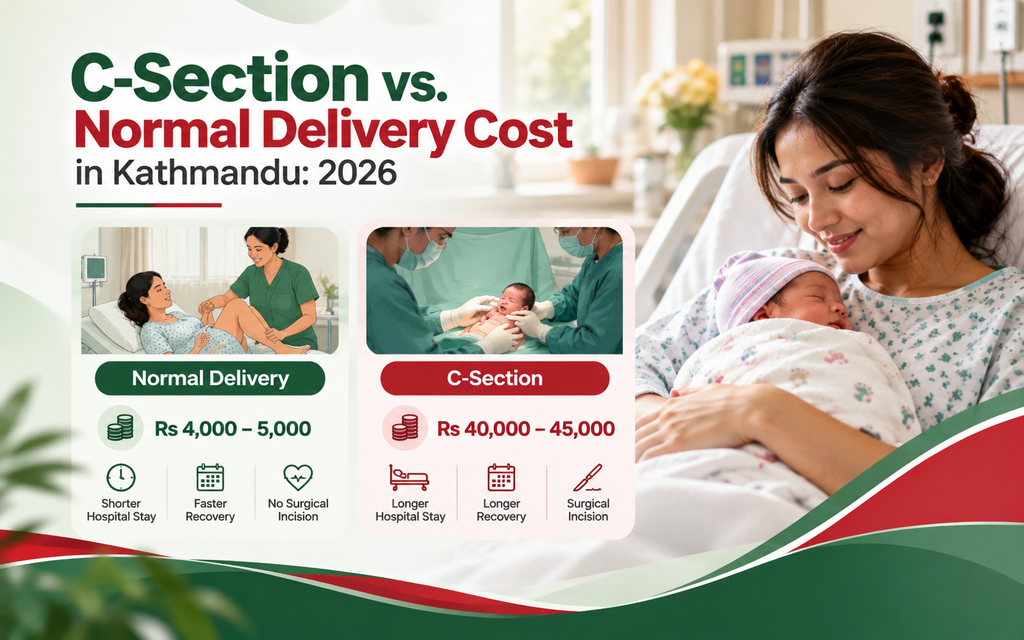
At KNMC Hospital, a normal delivery costs between Rs 4,000 and 5,000 (delivery only), while a C-section is around Rs 40,000 to 45,000 (including the surgery). The amount will vary depending on the complications, length of stay in the hospital and any other care needed for either the mother or the baby, so you will need your OBGYN to tell you the exact cost for your situation.
What Is Normal Delivery?
A normal delivery (vaginal delivery) is when the baby comes out through the birth canal without surgery. There are three stages to it – the labour and dilation of the cervix, the birth itself, and the delivery of the placenta. This is the easiest and usually the way most people choose to give birth if they are having a healthy, low risk pregnancy.
What Is a C-Section (Cesarean Section)?
A C-section is a surgical delivery in which the baby is delivered through an incision made in the mother’s abdomen and uterus. This is under spinal or less often general anaesthetic. You can schedule C-sections in advance for known medical reasons prior to the onset of labour or you can do an emergency C-section if something happens during labour.
Difference Between Normal Delivery and C-Section
| Factor | Normal Delivery | C-Section |
| Method | Through the birth canal | Surgical incision in the abdomen |
| Anesthesia | Usually none, or an epidural if pain relief is chosen | Spinal or general anesthesia |
| Duration | Hours, varies widely | Usually 45 minutes to an hour |
| Hospital stay | Often 1-2 days | Usually 3-5 days |
| Recovery time | Days to a couple of weeks | Typically 4-6 weeks |
| Scarring | None | A lower abdominal scar |
| Cost at KNMC | Approx. Rs 4,000-5,000 | Approx. Rs 40,000-45,000 |
Talk to an OBGYN About Your Delivery Options
Every pregnancy is different, and a table can only tell you so much. If you're expecting and want to understand what's realistic for your specific situation, KNMC's Obstetrics and Gynecology team can walk you through it based on your health and how your pregnancy is progressing. Book an appointment or contact us to speak with a doctor directly, or call 01-4771556.
Benefits and Risks of Each Delivery Method
Benefits & Risks of Normal Delivery
Benefits:
- Shorter hospital stay and generally faster recovery
- Lower risk of surgical complications, like infection at an incision site
- Earlier mobility after birth
Risks:
- Labour can be lengthy and unpredictable
- Risk of tearing, which may need stitches
- In rare cases, complications during labor may still require an emergency C-section
Benefits & Risks of C-Section
Benefits:
- Planned and predictable timing when it's a scheduled procedure
- Can be life-saving for the mother or baby when medically necessary
- Avoids labor entirely, which matters for certain medical conditions
Risks:
- It's major abdominal surgery, with the risks that come with any surgery, such as infection or bleeding
- Longer hospital stay and recovery time
- Future pregnancies need careful planning with your doctor
Recovery and Post-Delivery Experience
Normal Delivery Recovery
Most women can walk within hours of delivery and go home within a day or two. Some soreness, especially if stitches were needed, is normal for a week or two. Many women feel largely back to their usual routine within a few weeks.
C-Section Recovery
Since it's a surgical procedure, recovery takes longer. Movement is encouraged early to support healing, but the incision needs real time, typically 4-6 weeks, before returning to normal activity, and longer before any strenuous exercise. Pain medication and rest in the first week or two make a real difference.
Which is better: normal delivery or C-section?
Neither is universally "better." A normal delivery is generally preferred for a healthy, low-risk pregnancy because of the shorter recovery and lower surgical risk. A C-section becomes the better, sometimes essential, option when there's a medical reason for it, such as the baby's position, certain complications, or a health condition that makes labor risky. Your OBGYN's recommendation is based on your specific pregnancy, not a general preference for one method over the other.
Cost of Normal Delivery vs. C-Section in Kathmandu
At KNMC Hospital, Kathmandu:
- Normal delivery: Approximately Rs 4,000-5,000 (delivery only)
- C-section: Approximately Rs 40,000-45,000
Expert Advice from KNMC Hospital, Kathmandu
KNMC's Obstetrics and Gynecology department includes three consulting doctors:
- Dr Rosy Sharma, Obstetrics and Gynecology (NMC 9146), has 15 years of clinical experience. Her focus areas specifically include delivery care and prenatal care, alongside laparoscopic gynecology, menopause management, and reproductive ultrasound. She also treats other gynecological conditions requiring surgery, including laparoscopic removal of ovarian cysts. MBBS from Kathmandu University, MD in Obstetrics and Gynecology from Tribhuvan University.
- Dr. Nisha Rai, Consultant Obstetrician and Gynaecologist (NMC 4543), has 14+ years of clinical experience, providing general obstetric and gynecological care. MBBS from Kathmandu University/College of Medical Sciences (2002), MD in Obstetrics and Gynecology from Tribhuvan University Institute of Medicine (2012).
- Dr. Narayan Prasad Paudel, Obstetrics and Gynecology (NMC 3609) has 14+ years of clinical experience, and is also a consulting doctor in the department.
All three see patients through KNMC's OPD, Sunday to Friday (after 5PM).
Common Myths About C-Section That Should Be Corrected
- Myth: Once you have a C-section, every future delivery must also be a C-section.
Fact: This isn't automatically true. Vaginal birth after cesarean (VBAC) is safe for most women with a prior C-section, according to major medical bodies including the NIH and ACOG. The risk of uterine rupture with a low transverse incision is low, generally cited around 0.5-1%. Whether VBAC is right for you depends on your specific history and needs to be discussed with your doctor.
- Myth: A C-section is the "easy way out" and avoids pain entirely.
Fact: A C-section is major abdominal surgery, not a pain-free shortcut. There's real post-operative pain and a longer recovery than most people expect.
- Myth: C-section recovery is quicker or more convenient than a normal delivery.
Fact: It's usually the opposite. Because it's surgery, healing genuinely takes longer, typically 4-6 weeks, compared to a normal delivery.
- Myth: Babies born by C-section are less healthy than those born vaginally.
Fact: Not true. In many cases, a C-section is done specifically to protect the baby's health. Long-term health isn't determined by delivery method alone.
- Myth: "Painless delivery" is another name for C-section.
Fact: They're different things entirely. Painless delivery refers to epidural pain relief during a normal vaginal delivery. A C-section is a separate surgical procedure with different anesthesia, recovery, and cost.
Conclusion
Both normal delivery and C-section are safe, well-established ways to bring a baby into the world, and the right one for you depends on your health and how your pregnancy and labor progress, not a fixed preference either way. Knowing the real cost, recovery time, and facts (not myths) for each helps you prepare with fewer surprises. KNMC's Obstetrics and Gynecology team is available to guide that decision based on your specific pregnancy.
Frequently Asked Questions
Is it possible to have a vaginal birth after a C-section?
Yes, for most women. This is called VBAC (vaginal birth after cesarean), and major medical guidelines consider it safe for the majority of women with a prior cesarean, particularly with a low transverse incision. Your OBGYN will assess whether it's right for you specifically.
What happens during an emergency C-section?
If complications arise during labor, the medical team moves quickly to perform the surgery, usually under spinal anaesthesia if there's time, or general anesthesia if speed is critical. The priority is the safety of both mother and baby, and the hospital team is equipped to act fast when this happens.
Is normal delivery always cheaper than a C-section?
At KNMC, yes, a normal delivery (approximately Rs 4,000-5,000) costs significantly less than a C-section (approximately Rs 40,000-45,000), since a C-section is a surgical procedure with associated operating theatre and anaesthesia costs. But the choice between them should be based on medical need, not cost alone.
Does "painless delivery" mean C-section?
No. Painless delivery refers to using an epidural for pain relief during a normal vaginal delivery. It's a different thing from a C-section, which is a surgical procedure.
How long is the hospital stay for each delivery type?
Normal delivery typically involves a stay of 1-2 days, while a C-section usually requires 3-5 days, depending on recovery and whether any complications arise.
Sources
- Medications for Pain Relief During Labor and Delivery — American College of Obstetricians and Gynecologists (ACOG)
- C-Section — Aftercare — MedlinePlus (U.S. National Library of Medicine)
- FIGO Good Practice Recommendations for Vaginal Birth After Cesarean Section — PMC (National Institutes of Health)
- Delivery After Prior Cesarean: Maternal Morbidity and Mortality — PMC (National Institutes of Health)
Department: Obstetrics and Gynaecology
Consulting Doctors:
Dr Rosy Sharma (NMC 9146, 15+ years),
Dr Nisha Rai (NMC 4543, 14+ years),
Dr Narayan Prasad Paudel (10+ Years NMC 3609)
Book a consultation with KNMC's Obstetrics and Gynaecology team:
01-4771556 | Book Appointment | Contact Us
Follow KNMC: Facebook | Instagram | LinkedIn | TikTok