Medically reviewed by KNMC Hospital Last updated: September 2026
What Are Ovarian Cysts (डिम्बाशयको सिस्ट)?
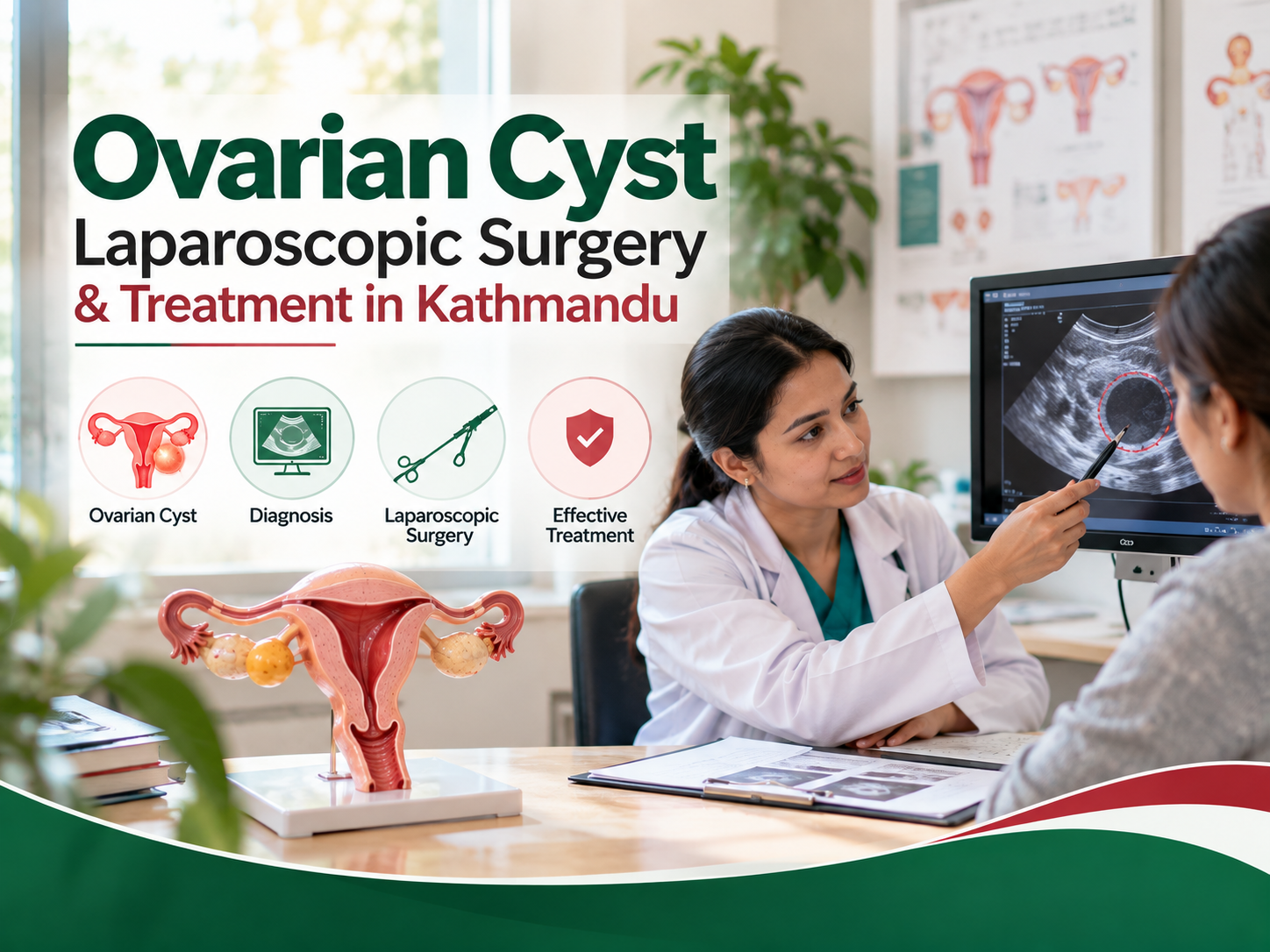
An ovarian cyst is a fluid-filled sac that forms on or inside an ovary. Most women will develop at least one ovarian cyst at some point in their reproductive life, and the large majority are harmless and go away on their own without any treatment. A smaller number need monitoring or, in some cases, surgery, particularly if they grow large, cause pain, or don't resolve on their own.
Types of Ovarian Cysts
Functional Ovarian Cysts
These are the most common type, and they form as a normal part of the menstrual cycle rather than as a sign of disease.
- Follicular cysts: Form when the sac holding an egg doesn't release it properly during ovulation.
- Corpus luteum cysts: Form after ovulation, when the follicle that released the egg reseals and fills with fluid instead of breaking down normally.
Non-Functional or Pathological Cysts
These aren't related to the normal menstrual cycle and are more likely to need medical evaluation.
- Dermoid cysts (teratomas): Contain tissue such as hair, skin, or teeth, and are usually noncancerous.
- Endometriomas ("chocolate cysts"): Form when tissue similar to the uterine lining grows on the ovary, a sign of endometriosis. They're often filled with old, dark blood, which is where the nickname comes from.
- Cystadenomas: Develop on the surface of the ovary and may contain thin, watery fluid or a thicker, mucus-like fluid.
- Malignant (cancerous) cysts: Uncommon, but this is why cysts that look unusual on imaging are often monitored closely or removed.
Common Symptoms of Ovarian Cysts
- Pelvic pain or a dull ache in the lower abdomen, often on one side
- Bloating or a feeling of fullness
- Pain during intercourse
- Irregular periods
- A frequent urge to urinate, if the cyst presses on the bladder
- Sudden, severe pain, nausea, or vomiting, which can signal a cyst has ruptured or the ovary has twisted (this needs urgent care)
Many small cysts cause no symptoms at all and are only found during an unrelated scan or exam.
Causes and Risk Factors of Ovarian Cysts
Common causes:
- Abnormal cell growth: Some cysts, such as dermoid cysts or cystadenomas, develop from cells growing in an unusual way.
- Endometriosis: In women with more advanced endometriosis, tissue can attach to the ovary and form an endometrioma.
- Polycystic Ovary Syndrome (PCOS): Can cause many small cysts to develop on the ovaries.
- Pelvic inflammatory disease (PID): Severe pelvic infections can spread to the ovaries and lead to cyst formation.
Risk factors:
- Fertility medication: Drugs used to induce ovulation can increase the chance of developing cysts.
- Pregnancy: Occasionally, the follicle that forms during ovulation stays on the ovary throughout pregnancy and can grow larger.
- A previous ovarian cyst: Having had one cyst makes another more likely.
- Being in your reproductive years: Functional cysts are more common before menopause.
Diagnosis for Ovarian Cysts
- Medical history: A review of your symptoms, menstrual cycle, and any relevant risk factors.
- Physical examination: Checking for pelvic pain, tenderness, or a noticeable mass.
- Imaging tests: Usually an ultrasound first, sometimes followed by a CT scan for a closer look at the ovaries and surrounding tissue.
- Blood tests: Can check hormone levels and, in some cases, tumor marker tests to help rule out a cancerous cyst.
Why Timely Treatment Matters
Most ovarian cysts are harmless and resolve without treatment, but ignoring symptoms can occasionally lead to complications, such as the cyst rupturing or causing the ovary to twist (ovarian torsion), both of which can cause sudden, severe pain and need urgent care. Getting a cyst properly evaluated, rather than assuming it's nothing, is what allows a doctor to catch the small number of cases that do need closer monitoring or treatment before they become an emergency.
Treatment Options for Ovarian Cysts
Treatment depends mainly on the cyst's size, type, symptoms, and whether it appears likely to resolve on its own.
- Watchful waiting: For small, simple cysts with no concerning features, monitoring with a follow-up ultrasound is often all that's needed, since many resolve on their own within a few menstrual cycles.
- Medication: Hormonal contraceptives don't shrink an existing cyst, but they can help prevent new functional cysts from forming.
- Surgery: Needed for cysts that are large, causing significant symptoms, growing, or that look suspicious on imaging. There are two things to decide here:
- What's removed: A cystectomy removes just the cyst, preserving the rest of the ovary and its function. An oophorectomy removes the entire ovary, which is sometimes necessary depending on the cyst's size, type, or location.
- How it's done: Laparoscopy (keyhole surgery) is the preferred approach for most cysts, using small incisions and a camera. Open surgery (laparotomy) is reserved for larger, more complex cysts, or if cancer is a concern.
What Is Laparoscopic Ovarian Cyst Surgery?
Laparoscopic ovarian cyst surgery is a minimally invasive procedure that removes an ovarian cyst through a few small incisions in the abdomen, using a thin camera (laparoscope) and specialized instruments, instead of one large open incision. It's the standard approach for most ovarian cysts that need surgical removal.
Laparoscopic Ovarian Cystectomy vs Open Surgery
| Factor | Laparoscopic Surgery | Open Surgery (Laparotomy) |
| Incision size | A few small incisions | One larger incision |
| Pain after surgery | Generally less | Generally more |
| Hospital stay | Often 1-2 days | Usually longer |
| Recovery time | Faster, often 1-2 weeks | Longer, often several weeks |
| Best suited for | Most benign cysts | Large, complex, or suspicious cysts |
| Scarring | Minimal | More noticeable |
Your surgeon will recommend the right approach based on your cyst's size, type, and appearance on imaging, not just personal preference.
What Happens During Laparoscopic Ovarian Cyst Surgery?
- Anaesthesia: The procedure is done under general anesthesia.
- Small incisions: A few small cuts are made in the abdomen, usually near the belly button and lower abdomen.
- Camera-guided removal: A laparoscope is inserted to view the ovary, and the cyst is carefully separated and removed using fine instruments.
- Closing up: The incisions are closed with small stitches, which typically leave minimal scarring.
- Recovery room: Most patients are monitored for a short period before being moved to a hospital room, often going home within a day or two if there are no complications.
Cost of Ovarian Cyst Surgery in Kathmandu
KNMC Hospital offers an all-inclusive laparoscopic ovarian cyst surgery package priced at approximately Rs 50,000-55,000, covering lab tests, hospital stay, the operation itself, and medicines used in the operating theatre. Costs for open surgery or more complex cases may differ, and your surgeon will confirm the exact cost for your specific situation during consultation.
Factors Affecting the Cost of Ovarian Cyst Removal Surgery in Kathmandu
- Type and size of the ovarian cyst
- Surgical approach (laparoscopy vs open surgery)
- Hospital infrastructure and location
- Surgeon's experience
- Length of hospital stay
- Diagnostic tests and medications required
Meet the Laparoscopic Surgery Expert at KNMC Hospital
KNMC's Obstetrics and Gynecology department includes Dr. Jitendra Kumar Singh, Dr. Poonam Shah, and Dr. Narayan Prasad Paudel.
Dr. Nisha Rai is a Consultant Obstetrician and Gynaecologist with 14+ years of clinical experience. She provides specialized gynecological care, including laparoscopic surgical treatment. NMC No.: 4543.
Dr. Rosy Sharma is a Gynecologist and Obstetrician with 15 years of clinical experience, providing comprehensive gynecological and surgical care. NMC No.: 9146.
Dr. Narayan Prasad Paudel is an experienced Obstetrician and Gynaecologist at KNMC Hospital, providing specialized care for women’s health and gynecological conditions, including surgical treatment.
Why Choose KNMC Hospital for Ovarian Cyst Removal Surgery in Kathmandu?
- Experienced gynecologists and laparoscopic surgeons, trained in minimally invasive techniques
- Modern minimally invasive surgical facilities, supporting faster recovery for most patients
- Personalized treatment planning, since not every cyst needs the same approach
- A focus on preserving ovarian and fertility health wherever it's medically appropriate to do so
- Modern operation theatres and post-operative support, with the full pathway, from diagnosis to surgery to follow-up, available at one hospital
FAQs
Can an ovarian cyst go away without surgery?
Yes, most functional cysts resolve on their own within a few menstrual cycles without any treatment, which is why watchful waiting is often the first step for small, simple cysts.
How do I know if my ovarian cyst needs surgery?
Surgery is usually considered if the cyst is large, growing, causing significant pain, or shows features on imaging that raise concern. A gynecologist's evaluation is the only reliable way to decide.
Is laparoscopic ovarian cyst surgery painful?
Most patients have significantly less pain than with open surgery, and discomfort is generally manageable with prescribed medication during the first few days of recovery.
Will removing an ovarian cyst affect my fertility?
A cystectomy is specifically designed to preserve the ovary and its function. Fertility impact is more of a consideration if an oophorectomy (full ovary removal) is needed, which your surgeon will discuss with you if it's relevant to your case.
How long is the recovery after laparoscopic ovarian cyst surgery?
Many patients return to light activities within 1-2 weeks, though this varies depending on the individual case and the complexity of the surgery.
Sources:
Ovarian Cysts, Types & Causes — Cleveland Clinic
Ovarian Endometrioma — Cleveland Clinic
Department: Obstetrics and Gynecology
Book a consultation with KNMC's Obstetrics and Gynecology team:
01-4771556 | Book Appointment | Contact Us
Follow KNMC: Facebook | Instagram | LinkedIn | TikTok